Sunday, 17 December 2017

Chinese Characters (video 1 and video 2)


你好/Hello,

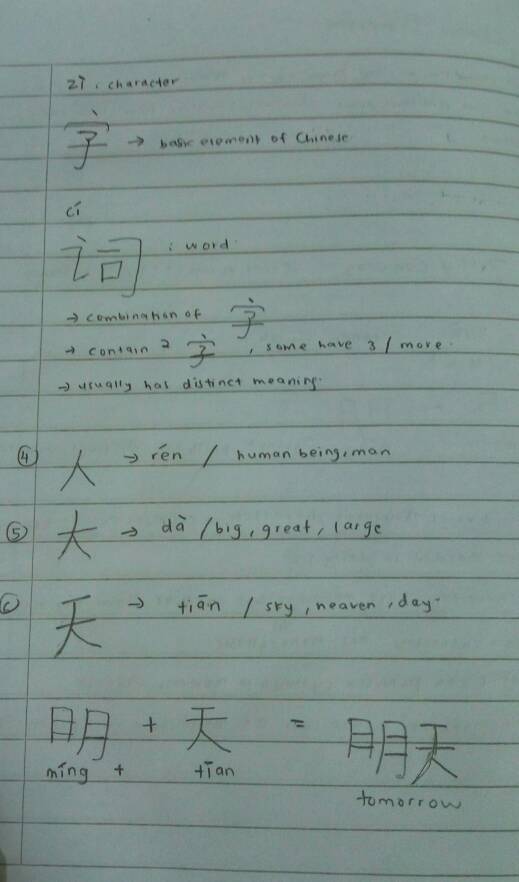
   Last week laoshi asked us to study the video about Chinese Characters. There are 4 videos in total. The videos provide me with the basic understanding and knowledge on how to form words by combining the characters. Thanks to the videos, I can increase my vocabulary because learning by watching the video is actually fun for me. I can pause the video anytime when I need more time to understand the video or when I want to jot down the information contains in the video. And here is the review on what I have learnt on the videos:

Video 1 :

  • Chinese characters evolved from earlier forms of hieroglyphs.
  • Today, we can still find some Chinese characters look like their ancestor.


  • There are tens of thousands characters in Chinese. Only 3000 to 4000 are needed in daily life.
  • Chinese characters have meanings but most of them are not words.
  • All Chinese characters are monosyllabic.
  • Only about 1200 possible syllable in modern Chinese.
  • So many homophones cause a lot of confusion in spoken Chinese. 


Video 2 :


Monday, 11 December 2017

New vocabulary week 3


Week 3 (di san ge xingqi) 
  • ·       Xuexi 学习 - learn
  • ·       Lizi 例子 - example
  • ·       Xia yi ge 下一个 - next
  • ·       Mei youti 没问题 - no problem
  • ·       Wei shenme 为什么 - why
  • ·       Cheng ren 成人 - adult
  • ·       Fu zeren 负责任 - take responsibility
  • ·       Bu zhi dao 不知道 - don't know
  • ·       普滕Puteng - Proton
  • ·       宝腾 Bao teng - Proton
  • ·       宝贝baobei  - baby ( my love one)

Tuesday, 5 December 2017

Class activity week 3


你好/Hello,
    Yesterday 老师/laoshi ask us to have a conversation with our class partner. We need to type what were instructed by our 老师/laoshi. However, we need to type it in Chinese characters so that we can be familiarize with the Chinese characters. For me, it is a fun class activity because we could learn/  学习 it in an interactive way.


Monday, 4 December 2017

Pinyin Practice


你好/Hello,

     During the first week, we learnt about Pinyin during the lecture. Pinyin consist of three elements which are initial,tone and finals. We learnt it in the lecture and my laoshi /老师 also upload some videos for us so that we can improve our understanding when we watch the video. Apart from that, laoshi /老师 also instructed us to do some exercise about Pinyin on the initial,tone and finals so that we can practice more.


Here are the result of my exercise.Honestly, I admit that it is not that easy to score 30 and to have only maximum of 10 errors. I have to do it for many times in order to success and also ask some help on it.


Pinyin

 What is Pinyin?

  • Pinyin is the Romanization of Chinese characters based on their pronunciation.
  • Pinyin literally translated into "spell sound".
  • In other words,spelling out Chinese phrases with letters from English alphabet.
  • Consist of three elements : initial,tone,final.
Initial
  • Initial always put at the beginning of syllable.
  • can use only one initial in a syllable.
  • each initial is made up by 1 or 2 letters.
  • there are 23 initials in total in Chinese. (23 + 2 ), 2 of 0 initials.

Final
  • the final is put after the initial.
  • we can only use one final in a syllable.
  • a final can be a syllable by itself without the initial or the tone.
  • each final is made up of one to four letters.
  • there are 35 finals in Chinese.


Tone

  • the tone notification mark is always added above final (to be specific,the vowel in the final)
  • can only use one tone in a syllable.
  • sometimes no tone is used.
  • there are 4 tones in Chinese : first tone,second tone, third tone, fourth tone.
  • refer to pitch in syllable : low pitch, mid-low pitch, middle pitch, middle high pitch, high pitch. 


New vocabulary week 2


Week 2

Dianming 点名 : name

Ming bai 明白 : understand

Bu ming bai 不明白 : do not understand

Ting hen duo 听很多 : Listen a lot

Qu 去 : go with

Wo 我 : me

Ni 你 : you

Ta 他 : He

he shui喝水 : drink water

he guo zhi 果汁 : drink juice

Qing shuo yi shuo 请说一说。: say something

Ni jiehun le ma? : are you married

Dui bu qi对不起 : I am sorry

wo hai meiyou ting 我还没有听。: I have not heard yet

Wo hen e我很饿。: I'm very hungry

Wo  hen bao我很饱。: I'm very full

...... ma? : to ask question

 Ni ne? : how about you

Ni e ma? : are you hungry?

Guge xiansheng 谷歌先生 : Google

Youdi xiaojie 优蒂小姐 : Youtube

Ni hao 你好 : Hello

Wo shi ....我是 : my name

Zhe shi 这是 : this is

 kaishi开始 : start

Zhe shi shui? : who is this?


Ni jiao shenme  mingzi? : what is your name?

ren : human

suibian : simply do

wangji :forget


New Vocabulary for week 1


Week 1 

New Word shengci

Qing jin 请进 : please enter

Shenme 什么 : what

Zenmeyang 怎么样 : How about it

Weishenme 为什么 : why

Hen men很闷 : very boring

Qin ai de 亲爱的 : Dear

Hen you yong很有用 : very useful

Tiaozhan 挑战 : challenge

 Hen nan 很难 : difficult

Dao到 : to

Meiyou lai 没有来 : Did not come